


Weed Control Under an Electric Fence: Stop Voltage Loss
Electricercas team · October 17, 2026 · 5 min read
Key takeaways
- Every leaf touching the wire leaks to ground
- Moisture multiplies voltage loss
- Keep a clean strip on both sides of the fence
- Put the bottom wire on a cut-out switch
- Test far-end voltage every month
You can own the best energizer on the market, brand-new insulators and a perfect ground system, and still watch your fence lose strength month after month. On most farms the culprit isn't inside the charger box but on the ground: grass, brush, vines and branches growing up into the wire. Every leaf that touches the line is a small path for current to leak to ground, and hundreds of those paths together can drag voltage down right in the growing season, when grass shoots up fastest. This article explains why weeds hit electric fences so hard, how to measure the impact, and which weed control methods under an electric fence work best for your operation.
Why weeds "eat" your voltage
Electric fence current tries to complete its circuit through the ground. Normally that only happens when an animal touches the wire. But moist vegetation conducts too: when a leaf touches the wire, a little energy bleeds off with every pulse. One leaf barely registers; a 650-foot (200 m) stretch with tall grass brushing the bottom strand is like having a permanent load hooked to your fence.
The effect gets worse with:
- Moisture: morning dew and rain make vegetation far more conductive.
- Thick, sappy plants: vines, broadleaf weeds and cane conduct more than dry grass.
- Low strands: the wire closest to the ground gets the most contact.
- Fence length: losses add up along the entire line.
The result is a fence that reads fine near the energizer but drops off at the far end. Animals find that weak stretch and start getting through.
How to tell if weeds are the problem
- Measure voltage at the energizer with the fence connected. Write it down.
- Measure at the farthest point of the fence.
- Disconnect the fence and measure at the terminals: if voltage jumps significantly, the load (leakage) is on the line, not in the unit.
- Walk the fence in sections, testing at intervals or using a fault finder. Where voltage drops sharply, there's a major leak.
- Compare morning and afternoon: if voltage is much lower with morning dew than at midday, vegetation is a key factor.
For more on testing, see how to test electric fence voltage.
Weed control methods
There's no single perfect method; a combination almost always works best. Here's a summary:
| Method | Pros | Cons | Best for |
|---|---|---|---|
| String trimmer or machete | Cheap, precise, no chemicals | Frequent labor | Small farms, short runs |
| Tractor mower or rotary cutter | Fast on long, straight runs | Needs access and fairly level ground | Long boundaries on mowable terrain |
| Herbicide strip | Long-lasting control | Requires responsible handling, care near water | Long runs with aggressive weeds |
| Controlled grazing | Uses the forage | Animals may pressure the fence | Rotations with trained stock |
| Mulch or ground cover | Reduces regrowth | Upfront cost, upkeep | Short runs near buildings |
| Raising the bottom wire | Less contact | May let calves or sheep under | Only if your livestock allows it |
| Switchable bottom wire | Keeps the rest of the fence strong | Bottom wire loses effect when off | Peak growing season |
Mechanical control
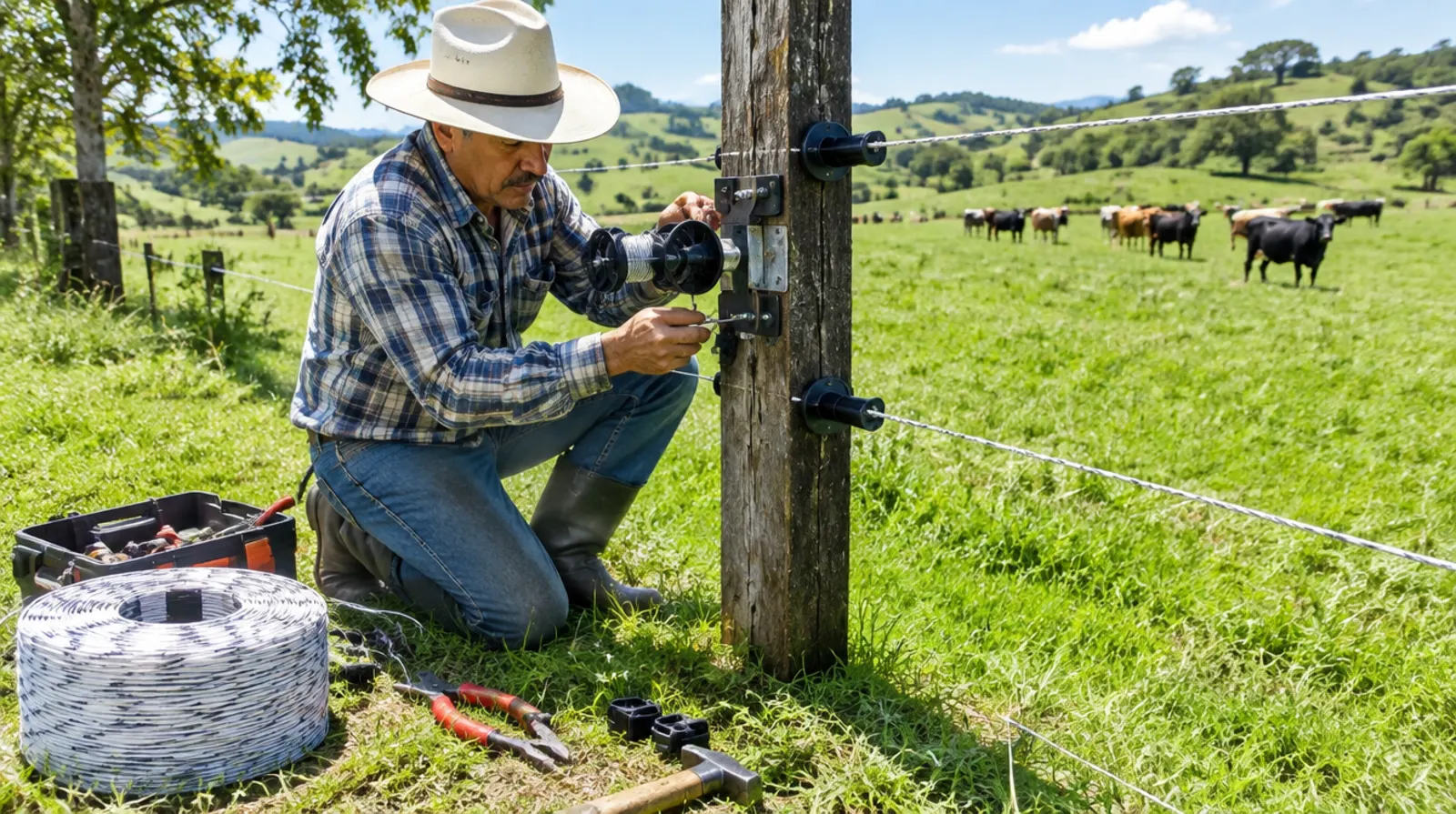
This is the most common approach. Aim to keep a clean strip about 20 inches to 3 feet (50 cm to 1 m) wide on each side of the fence. Schedule cuts by season: during peak growth you may need to trim every 3 to 4 weeks; in the dry season, far less. Be careful with string trimmers near insulators and wire: one hit can crack an insulator or cut tape, creating a worse leak than the weeds.
Responsible chemical control
On long runs, herbicides applied in a strip can save a lot of labor. If you use them, follow these general guidelines:
- Use only products registered with your local agricultural authority (the EPA and state agencies in the U.S., the ICA in Colombia) and follow the label exactly.
- Keep required buffer zones around streams, springs and ponds.
- Spray in calm conditions and at the recommended times of day.
- Respect the livestock re-entry or grazing intervals stated on the label.
- Ask an agronomist or extension agent which product and rate suit your weeds.
You can browse inputs in our agricultural products category.
Grazing and forage management
In rotational grazing, animals will graze the grass along the fence if the layout lets them reach it. That works well with trained stock and a hot fence. A useful practice is following adult cattle with sheep or calves to clean up the edges. More ideas in rotational grazing with electric fence.
Designing a fence that resists weed pressure
Beyond cutting, you can design the fence so vegetation affects it less:
- Bottom wire on its own circuit: wire it through a cut-out switch so you can turn off just that strand during peak growth without losing the rest of the fence.
- An energizer with headroom: more output joules handle vegetation load better. Browse energizers and read joules, miles and acres explained.
- A solid ground system: with poor grounding, every leak hurts twice as much.
- Insulators in good shape: a cracked insulator plus a vine equals a dead short. Check our insulators.
- Correct height: set the bottom wire at the minimum your animals require, no lower.
- Heavier-gauge wire: lower resistance means the pulse arrives stronger at the far end. See fence wire.
Practical control calendar
- Before the growing or rainy season: deep clean of the entire line, insulator inspection and voltage readings.
- During peak growth: walk the line every 2 to 4 weeks, cut critical strips, test voltage at the far end.
- As the dry season starts: general trim and removal of dead branches that wind could drop onto the line.
- Dry season: monthly checks; watch for nearby burns that could damage insulators and tape.
- Always: log voltage readings in a notebook or on your phone to spot trends.
Warning signs
- Far-end voltage drops a little more each week.
- You hear snapping or see sparks along vegetated stretches, especially at night.
- Animals start grazing under the bottom wire.
- Tape or polyrope shows burn marks.
Keep your fence clean and strong
Weed control matters as much as choosing a good energizer. At Electricercas we can set you up with high-headroom energizers, cut-out switches, insulators and agricultural products to keep your fence lines clear. Estimate materials with our fence calculator, check our installation guides, or contact us on WhatsApp at +57 305 453 5264. We ship from Medellín throughout Colombia and internationally.
Frequently asked questions
How much voltage do weeds take from an electric fence?
It depends on vegetation density, moisture and fence length. On stretches with tall, dewy grass, the drop can be enough that the fence no longer holds animals. Test voltage at the far end and compare it with the fence disconnected to find out.
How often should I clear weeds from my fence line?
During peak growing season, many farms trim critical stretches every 3 to 4 weeks. In the dry season, a monthly check is usually enough. Let your voltage readings guide the schedule.
Can I spray herbicide under an electric fence?
Yes, as a strip application handled responsibly. Use registered products, follow the label, keep buffer zones near water and respect grazing intervals. Ask an agronomist or extension agent which product and rate to use.
Need help with your fence?
We ship worldwide. Message us and an advisor will help you choose the right setup.